
This article with photographs was published at NewsDeeply’s Women and Girls.
CALI, Colombia – Nandy Mondragon swallows her fear of heights and climbs the scaffolding leaning against a wall in Siloe, one of the most dangerous and impoverished mountainside neighborhoods in Colombia’s one-time “crime capital,” Cali.
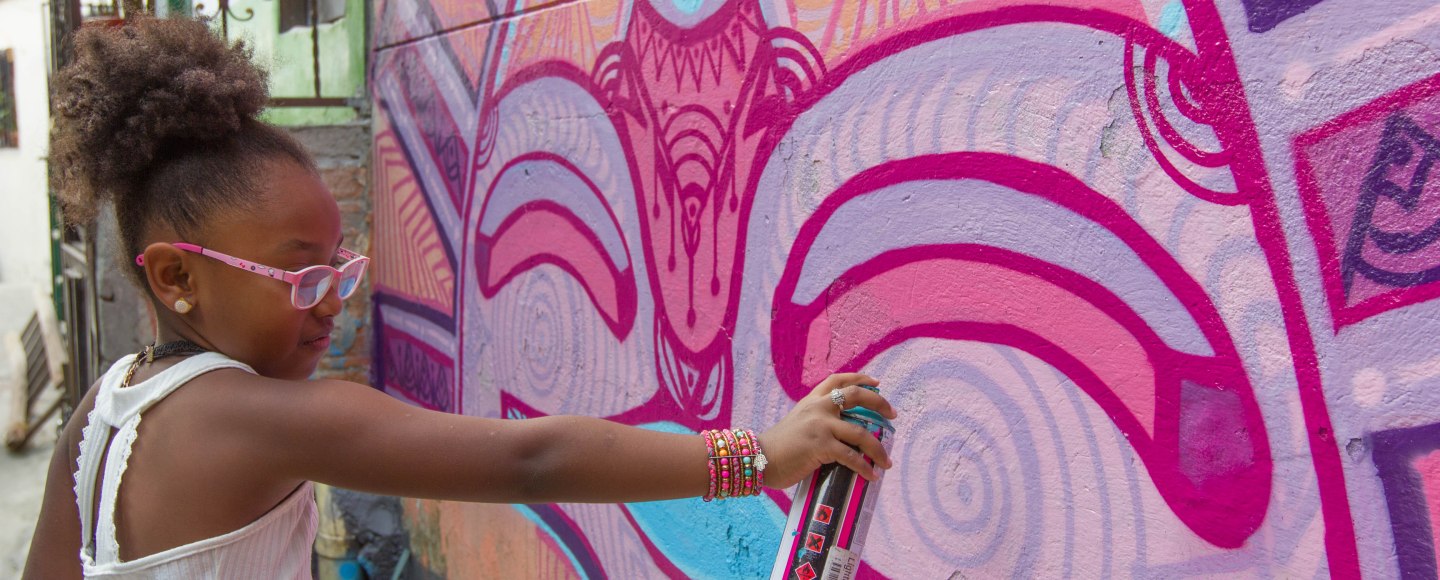
As Mondragon sketches the shape of a woman’s face with her spray can, a local girl looks on, eyes wide. Women are still fairly new to Colombia’s rapidly growing, semi-licit graffiti scene. Lax regulation and a surplus of urban space have made the art form massively popular in the major cities of Bogota, Medellin and Cali.
For several decades, the street-art world has been almost exclusively dominated by men, and entrenched sexism presents a serious challenge for women breaking into the scene, both in terms of recognition for their work and their safety on the streets.
“As a woman, you are told not to walk around alone, to always have a man by your side. Imagine going out late at night as a woman to paint here. There are lots of fears that have been put in your head. I think this is one of the reasons we don’t have that many female street artists,” said Jeffer Toscanini, an anthropologist and a guide with Bogota Graffiti Tours.
But with women artists increasingly staking their claim over graffiti, the art form is becoming a public platform for female empowerment. These artists are questioning traditional gender roles, and denouncing the sexism and racism that have disproportionately affected Afro-Colombian and indigenous women in the country.

“I mainly paint Afro women because of the issue of racial discrimination, which really impacts me,” says Mondragon, who first translated her designs from notebooks to the neighborhood two years ago to extend the reach of her empowering representations of the beauty of dark-skinned women. “You can express yourself on the walls because they’re public and everyone can see them, from the woman selling ‘arepas’ [ground-maize patties] on the corner to the homeless man living on the street. The message can reach every person.”
But the prevalence of street harassment, such as catcalling, means she only feels comfortable going out to paint if accompanied by her boyfriend and fellow street artist, Wilson Silva. Otherwise, she explains, “You can feel men looking at you. It’s unpleasant.”

Across the country, graffiti has been harnessed to reclaim and recuperate previously neglected urban spaces, as well as to prevent and denounce violent crime, including gender-based violence.
In 2015, the message “Femicides = a human rights violation” was scrawled across a public wall in Cali as part of an arts-based public awareness campaign. The mural was painted by Ellas Hacen Falta (loosely translated as “These Women are Missing”), a collective of men and women who say they are “repairing absences” of women lost to femicide through commemorative art.
The department of Valle del Cauca, where Cali is located, has one of the highest rates of femicide – the targeted killing of women based on their gender – in Colombia.
Gender discrimination within the street art scene has pushed some female artists to hide their identities or pursue styles that are perceived as more “masculine.” At the start of her 16-year career in graffiti, De la Roca, a Venezuelan artist now based in Bogota, said she avoided gender discrimination by choosing an ambiguous name.
“I specifically chose my artistic tag ‘De la Roca’ because for a long time I was anonymous. I liked it because people didn’t know I was a woman, so I could get real opinions on whether my work was good or bad. Not things like, ‘She’s pretty good for a woman.’ Now, the scene is becoming more equal as women show their skills and success,” she says.
Several Bogota-based street artists have taken a similar approach, such as Erre, who was assumed by many to be a man when her skull-studded rock ’n’ roll-inspired designs first began popping up around the city. Now, Erre has been embraced by the global graffiti scene as a woman artist, and one of her latest designs features her in self-portrait as a graffiti superwoman with an open coat trailing behind her like a cape.

Daniella Rocha goes by the street artist name Muisca, in homage to the indigenous civilization that once occupied the area surrounding her hometown of Bogota. While studying in Toronto, Muisca began painting on the streets for the first time with the encouragement of a local all-male crew.
“My approach is to give pre-Columbian designs a fresh, crisp style. My art and my tag are a form of education about our shared indigenous roots,” she says. “We can’t forget what we were, what we are and what was stolen from us. I’m trying to revive that on the streets with graffiti.”
In February 2017, Muisca was invited to share her indigenous-inspired murals with marginalized communities in Medellin, Cali and Bogota as part of the Surfest international graffiti festival. Although painting in neighborhoods with high rates of crime and entrenched sexism posed challenges, Muisca said the experience made her feel stronger and more confident.
“As a woman I feel super-empowered because this isn’t something that many women would dare to do, and not because they’re scared, but simply because society itself tells women they aren’t strong enough to be in a place like that or that graffiti is too difficult.”
Melissa Vasquez Aristizabal’s illustrations and graphic design work were discovered on Instagram by internationally recognized street artists Crisp and Cochino Nino, who invited her to join them on the streets of Bogota. She hesitated at first, concerned about discrimination and her safety. But she now shares her pastel surrealist designs in the form of murals, stickers and pasteups across the Colombian capital.
“My work is recognizable because I tend to use a lot of pastel colors, so every time I paint something, [male graffiti artists] go and tag it. It’s exhausting. As a woman, I’ve felt vulnerable to that. You don’t even know if it’s because you’re a woman, because you’re on the streets, because they want to flirt with you, or something else,” Aristizabal says. But this targeted discrimination hasn’t stopped her from creating public art.
“We are creating, and making the city look more beautiful. In a place as grey and gothic as Bogota, to add color is important,” she says. “No one is better than anyone else. Not men, not women. We’re all part of the process and can learn.”
 Angelika Albaladejo
0 comments on “Street Artists Challenge Sexism with Spray Paint in Colombia’s Cities”